An AI data ingestion checklist proves that business data arrives completely, passes defined checks and remains traceable before an agent uses it.
A connected database is not automatically an agent-ready data foundation. The agent may be able to query it. However, that access has little value if yesterday's export never arrived, a partial file replaced a complete one or the same delivery was imported twice.
Start with one real workflow. Then test the path from the source system to the point where the data becomes available for AI-assisted work.
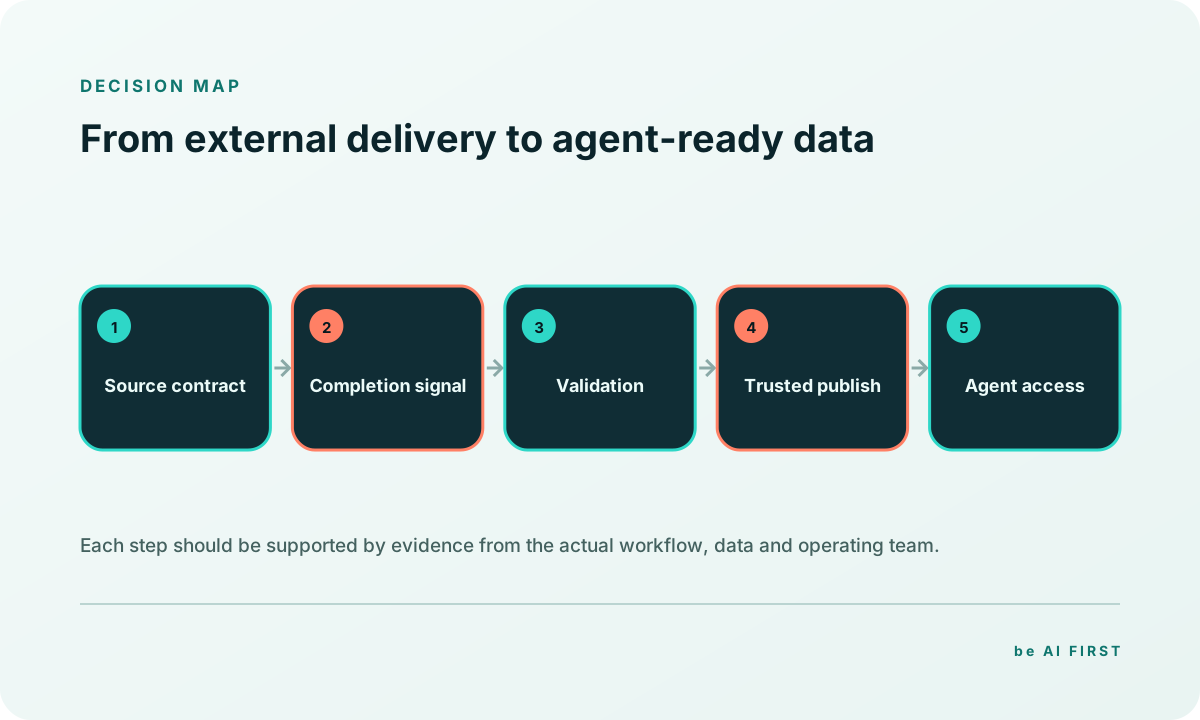
The AI data ingestion checklist starts with a source contract
Write down what the source promises before you choose infrastructure.
For each file, API or system connection, record:
- who owns the source;
- which records should arrive;
- the delivery format and expected schema;
- the stable identifiers used to join records;
- the expected frequency and delivery window;
- whether a delivery is a full snapshot or an incremental update;
- how corrections and deletions appear;
- who can approve a source change.
This contract can be short. Still, it must be specific enough to test. “The vendor sends JSON every night” does not explain how to recognize a complete export or what should happen when a field changes.
AWS's current data engineering guidance recommends defined ingestion patterns, orchestration, error handling, monitoring and validation against predefined rules. Those practices apply even when the final consumer is an AI agent rather than a dashboard.
1. Prove that the delivery is complete
Do not let the first sign of a file become permission to process it.
A large upload may appear before every byte is committed. Likewise, a multi-file export may arrive in stages. Therefore, define a completion signal. It might be a committed-upload event, a manifest or a separate success marker created only after the export finishes.
For example, Microsoft's Blob Storage event documentation distinguishes an initial SFTP create event from the final commit event. It also documents event identifiers, operation types and content length. The general lesson is simple: verify what an event means before treating it as proof of completion.
Your acceptance test should answer three questions:
- What exact event starts processing?
- How does the system know that every required object is present?
- What happens when the completion signal never arrives?
2. Validate the delivery before writing business records
Next, check the delivery against the source contract.
Useful checks can include:
- manifest contents;
- file count and expected names;
- row or record count;
- schema version;
- required fields and allowed types;
- checksum or content hash;
- date range and source identifier;
- relationships between parent and child records.
Choose checks that can catch a plausible operational failure. For example, a successful download does not prove that the file contains every record. Meanwhile, a valid JSON document does not prove that it uses the schema your application expects.
If a check fails, keep the rejected delivery separate from trusted records. Also record the reason. Do not silently coerce an unexpected structure into the current database merely to keep the pipeline moving.
3. Make repeated delivery safe
Assume that the same event or file may appear more than once.
Azure Event Grid uses at-least-once delivery. Its delivery and retry documentation also states that events can arrive out of order and that duplicates can still occur. Other queues and event systems have their own guarantees. Therefore, verify the behavior of the service you actually use.
Then give each import a stable identity. That identity may combine the source, export identifier, version and checksum. Before processing, check whether that exact delivery has already succeeded.
An idempotent import produces the same final state when it receives the same valid input again. Test that behavior directly. A duplicate should not create duplicate deals, invoices, customers or documents.
4. Separate raw delivery from trusted data
Preserve enough evidence to explain where a record came from.
A practical ingestion flow often has three states:
| State | Purpose | Example evidence |
|---|---|---|
| Received | Preserve what arrived | Original object, receipt time, source and content hash |
| Validated | Record why the delivery passed | Manifest result, schema version, counts and validation log |
| Published | Make approved records available | Import identifier, database transaction and completion time |
The exact storage pattern depends on the business. However, the system should let an operator trace a published record back to its delivery. It should also support replay after a defect is fixed.
NIST's AI RMF Playbook asks organizations to document data provenance, sources and transformation. An ingestion record gives that guidance an operational form.
5. Detect missing data as well as failed data
A failed import can create an error. A missing delivery creates nothing unless the system knows to expect it.
Therefore, monitor both conditions:
- a delivery arrived but failed validation or import;
- an expected delivery did not arrive within its window.
Send the alert to a named owner. Include the source, expected time, delivery or import identifier, failure stage and safe next action. Avoid alerts that say only “function failed.” They force the operator to reconstruct the entire context under pressure.
Also decide what the AI workflow should do while data is stale. It may show the last successful refresh time, restrict a task or stop altogether. That decision belongs to the business owner as well as the implementation team.
6. Preserve access rules throughout the pipeline
Agents should not gain broader access merely because data moved into a new database.
Map access at each stage:
- source system;
- delivery location;
- processing service;
- raw and rejected objects;
- trusted database tables;
- retrieval or agent interface;
- logs and support tools.
Use distinct identities for services and people where practical. Then grant only the access each one needs. In addition, prevent secrets and restricted fields from entering prompts, traces or broadly accessible logs.
This is one reason to design the ingestion path and the agent interface together. The database may be private while a debugging tool exposes its contents.
7. Test the failures before connecting an agent
Run representative acceptance tests before the AI depends on the data.
At minimum, test:
- one complete valid delivery;
- a duplicate delivery;
- a partial or corrupt delivery;
- an unexpected schema version;
- a wrong checksum or record count;
- a missing delivery;
- unavailable source or database;
- expired credentials;
- a safe replay after the defect is corrected.
For each case, define the expected database state, log entry, alert and recovery action. Then retain the test results with the implementation record.
8. Name the operating owner
Finally, assign responsibility for the live system.
Someone must approve source changes, review failed imports, rotate credentials, monitor cost and confirm that recovery still works. The implementation partner can support those duties. Still, the business should know who owns each decision.
Use the AI system handover checklist to document accounts, monitoring, runbooks and maintenance. If the ingestion design began as an AI-generated plan, apply the AI implementation plan review before committing the full workflow.
A working example from 101 Net Lease
101 Net Lease came to beAIfirst with a plan developed through work with Claude. The business needed external deal-data exports to land in a reliable data foundation. In addition, future agents needed a stable way to work with the resulting records.
We reviewed the plan, retained suitable decisions and changed parts that did not fit the operating requirement. The running Azure foundation uses private Blob delivery, Event Grid completion markers, Azure Functions and Azure SQL Database.
It automatically downloads completed exports and validates their manifests, row counts, schema versions and checksums. Then it calls the ingest service and writes approved data into Azure SQL. Missing-delivery and failed-import alerts feed the operating process through Log Analytics and Application Insights.
The point is not that every company needs those Azure services. The lesson is that an agent-ready database depends on the controls around the data, not just the table design. Read the verified 101 implementation case.
What a useful ingestion assessment should produce
Before commissioning a large platform, ask for a focused output:
- one documented source-to-destination flow;
- the source contract and completion signal;
- validation and duplicate-handling rules;
- trusted, rejected and replay states;
- acceptance tests for normal and failed deliveries;
- monitoring, alerts and recovery steps;
- access boundaries and named owners;
- a scoped recommendation to configure, integrate or build.
This makes the next investment easier to judge. It also exposes whether the source system, delivery process or operating team needs attention before an agent is added.
Bring one real data source
If an AI workflow will rely on incoming business data, book a conversation with Levi. Bring the intended task, one sample delivery and the failure that concerns you most. Leave out credentials and confidential records.
We can help you test the ingestion plan, choose the appropriate services and build the missing layer without turning a focused workflow into an unnecessary platform project.