An AI implementation plan review tests a proposed system against your real data, dependencies, controls, costs and operating responsibilities. It does this before you commit to building.
You may already have a detailed AI implementation plan.
Perhaps you spent several evenings working through the problem with Claude, ChatGPT or another capable assistant. It helped you turn your idea into tables, services, workflows and a plausible architecture. The plan may be thoughtful. It may even include technologies that fit the job.
However, one business-critical question remains: will this plan work with your actual data, systems, people and operating constraints?
An AI assistant can accelerate research and planning. However, it cannot inspect every assumption you omitted or negotiate access to a vendor system. It also cannot assign ownership of a failed import or prove affordability at your real transaction volume. A polished plan is useful input. It is not yet an implementation decision.
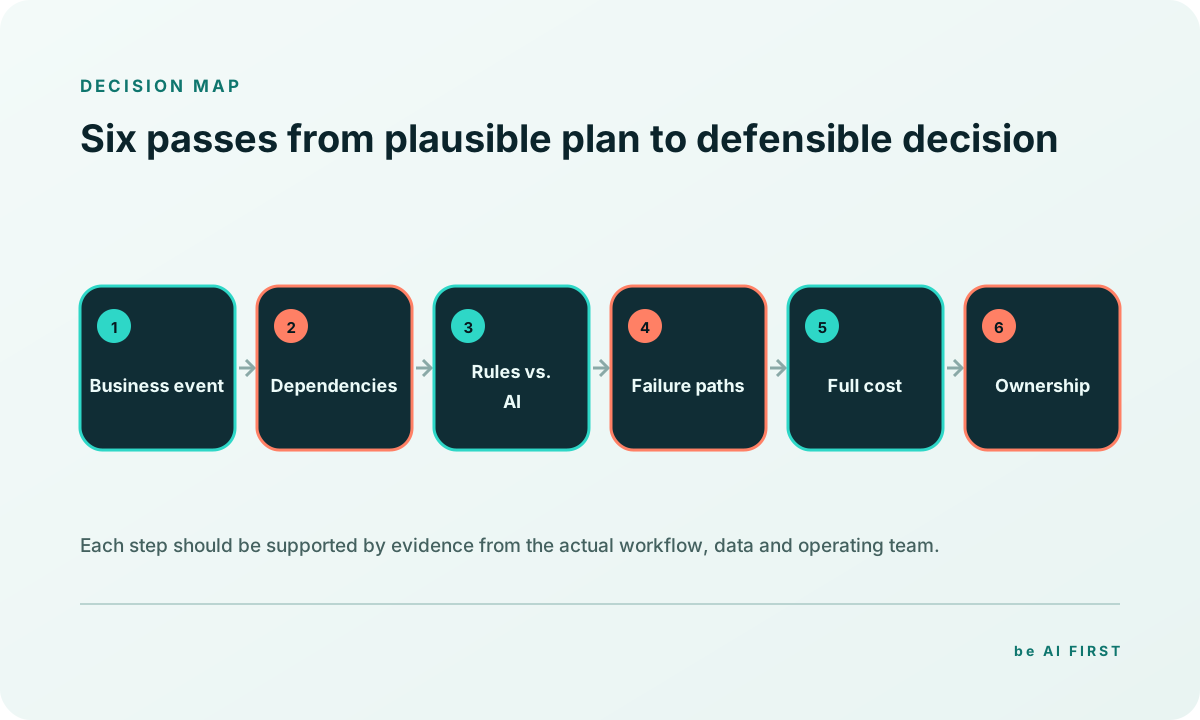
Before you commit business data or budget, review the plan in six passes.
1. Start with the business event, not the architecture diagram
A plan often begins with components: a database, model, vector store, agent framework, automation service or cloud provider. Reverse the order.
Write down the event that starts the workflow and the business result that ends it:
- What arrives, from whom and in what format?
- What must happen next?
- Which result is valuable to the business?
- Who reviews or approves it?
- What happens when the input is late, incomplete, duplicated or wrong?
This exposes a common planning failure: the plan covers only the happy path. Real operations live in the exceptions.
For example, “send the data to a database” is not a complete import plan. The system must recognize a completed delivery and reject a partial file. It must also validate the expected structure, prevent duplicate processing and alert someone when a delivery fails.
2. Verify every dependency the plan assumes
AI-generated plans frequently make reasonable-sounding assumptions about systems they cannot inspect. Create a dependency register and verify each item directly.
| Assumption to verify | Evidence you need |
|---|---|
| The source system can provide the required data | Actual export, API or integration documentation; sample payloads; frequency and access terms |
| The proposed service supports the workflow | Current provider documentation, region and account availability, limits and pricing model |
| The records can be joined reliably | Stable identifiers, ownership rules and examples of missing or conflicting data |
| The AI may use the information | Approved data classification, access boundaries, retention requirements and provider terms |
| The downstream system can accept the result | Supported interface, authentication method, rate limits and a responsible system owner |
| The company can operate the design | Named owner, monitoring, recovery procedure, documentation and required skills |
If one dependency is unknown, label it unknown. Do not let a confident paragraph turn an unverified assumption into an architectural fact.
3. Separate deterministic work from AI judgment
Many useful AI systems contain more ordinary software than AI.
File delivery, checksum verification, required-field validation, permission checks, database writes, retry limits and alerts should usually behave predictably. They are poor places to accept a model's variable output. Instead, reserve AI for work that benefits from interpretation. Examples include extracting meaning, drafting a response or recommending a next step for human review.
For every step, ask:
- Must the same input always produce the same result?
- Can a rule or standard software feature handle it more reliably?
- If AI is used, what output is allowed?
- How is that output checked before it changes data or triggers an action?
This decision can simplify the system, reduce operating cost and make failures easier to diagnose.
4. Test the plan against failures before building the happy path
Production readiness is not a list of technology names. It is a set of observable behaviors when reality differs from the plan.
Use representative examples to test at least these cases:
- a valid input;
- a duplicate input;
- a partial or corrupt input;
- an unexpected schema or document format;
- unavailable source or destination service;
- rejected credentials or changed permissions;
- an AI output that is plausible but wrong;
- a task that exceeds its expected time or cost;
- a human reviewer who rejects the result.
Define the expected behavior before implementation. Should the system stop, retry, quarantine the item, use a deterministic fallback or request human review? Who receives the alert, and what information will help that person resolve it?
This is consistent with current production guidance. The NIST AI Risk Management Framework Playbook organizes suggested actions around governing, mapping, measuring and managing AI risk. Microsoft's Well-Architected Framework evaluates reliability, security, cost, operations and performance. Neither framework can choose your architecture. However, both reinforce the need to examine the whole operating system rather than the model alone.
5. Calculate the cost of the completed business task
“The model is inexpensive” is not a cost model.
Estimate the cost of a successful completed task, including:
- model input and output;
- retrieval, tools and external APIs;
- storage, compute, networking and monitoring;
- retries and failed attempts;
- human review and exception handling;
- vendor support and ongoing maintenance.
Then test the estimate at normal, peak and failure volumes. A cheaper model that creates more retries or review work may cost more per usable result. A private deployment may fit a specific data, control or usage requirement. However, it also introduces infrastructure and operating responsibilities. Therefore, compare the full alternatives before deciding.
For a fuller measurement approach, see AI operating costs: calculate cost per successful task and our AI cost optimization service.
6. Decide who owns the system after launch
A plan remains incomplete until you name the responsible people.
Someone must own:
- the business outcome;
- source-data access and quality;
- infrastructure and credentials;
- AI evaluation and approval rules;
- monitoring and incident response;
- vendor and model changes;
- operating-cost review;
- documentation and handover.
“The consultant manages it” is too vague. “The AI agent will monitor itself” is equally vague. Instead, define the partner's responsibilities and what remains with your team. Also identify every dependency on a third-party provider.
Microsoft's current guidance for AI workloads on Azure covers nondeterministic behavior, application design, operations, testing and lifecycle roles. Those concerns still apply when an assistant produced the initial plan quickly.
A real example: from a plausible plan to an operating data foundation
101 Net Lease came to beAIfirst with a plan developed through work with Claude. The goal was to receive external deal-data exports and store the information reliably. In addition, the foundation had to support an agent-first way of working.
The value of the engagement was not copying that plan into Azure. We reviewed its assumptions and retained the decisions that fit. Then we changed unsuitable choices and implemented the operating details that make the system usable.
The running foundation uses private Blob delivery, Event Grid completion markers, Azure Functions and Azure SQL Database. It validates manifests, row counts, schema versions and checksums before ingestion. Finally, missing-delivery and failed-import alerts feed into operational monitoring through Log Analytics and Application Insights.
This does not prove that every company needs Azure or the same architecture. It demonstrates the difference between receiving a plausible plan and accepting responsibility for whether it works in the real business. Read the 101 implementation case.
What a useful AI implementation plan review should produce
You do not need another abstract strategy deck. A useful review should leave you with:
- a clear statement of the business flow and success condition;
- verified dependencies and explicitly unresolved assumptions;
- retained, replaced and deferred decisions, with reasons;
- a minimal implementation boundary;
- acceptance tests for normal and failure cases;
- a realistic operating-cost model;
- named responsibilities for launch and ongoing operation;
- a build, configure, buy or stop recommendation.
Sometimes the conclusion will be to configure an existing product. Sometimes it will be to build an integration, data foundation or private deployment. Sometimes the right decision is to stop before spending more money. The review has done its job if it makes that choice defensible.
Bring us the plan you already have
If you have an AI-generated plan, prototype or uncertain architecture, you do not need to start over. Book a conversation with Levi. Bring the current plan, its intended workflow and the constraint that concerns you most.
We will identify what to keep, what to change and what to prove before the system becomes part of your business.