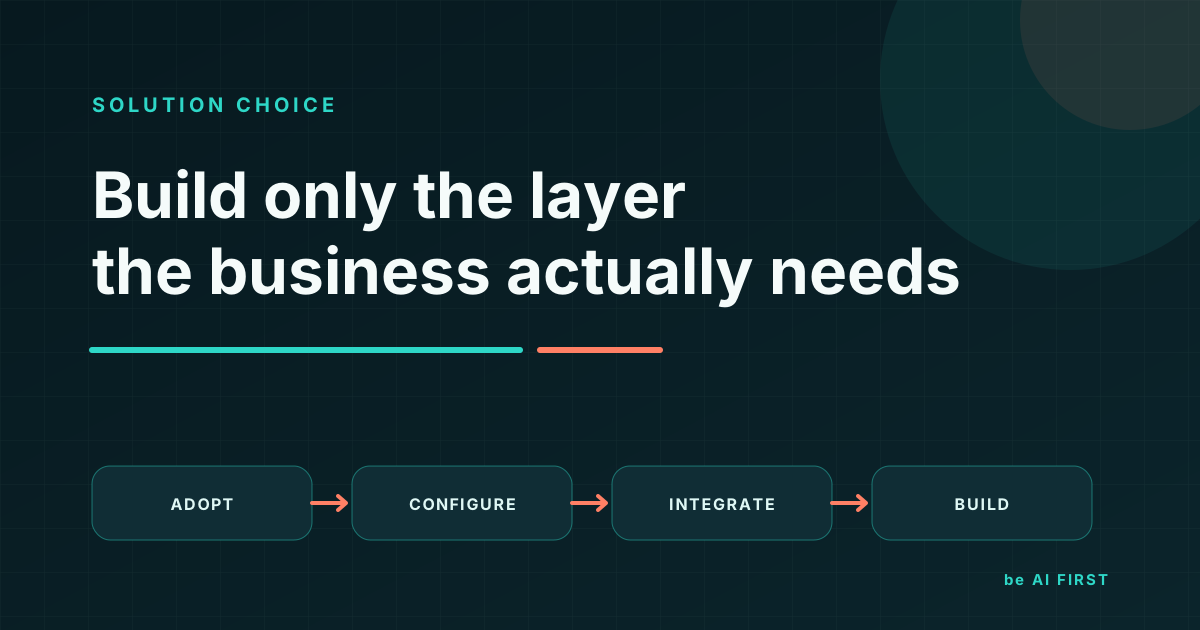
Consider custom AI when a specific business requirement remains unmet after you test the practical alternatives.
You do not need a custom AI system merely because your workflow matters.
You need one when a specific requirement remains unsolved after you have tested the practical alternatives.
That distinction matters because businesses have several options. They include built-in AI features, specialist products, automation, model APIs, integrations and custom applications. Therefore, “build or buy” is no longer a two-option decision.
Often, the best answer is to buy the commodity capability. Then customize the part that is distinctive to your data, workflow or operating requirements.
Start with the point where work breaks down
Avoid beginning with “we want an AI agent” or “we need a private model.” Instead, describe the event that creates work and the required result.
For example:
- Incoming deal files must be validated and made available for analysis.
- A proposal must be drafted from approved job details and a company template.
- A customer question must be answered from current product and account information.
- A coaching method must guide a client through a structured experience between human sessions.
Then identify the current failure:
- information is copied between systems;
- the existing AI cannot access the right source;
- users cannot tell whether the data is current;
- the output requires too much correction;
- the workflow violates a deployment or access requirement;
- usage becomes too expensive at the required volume;
- the product handles the common case but not a business-critical exception.
Use this requirement to test every option.
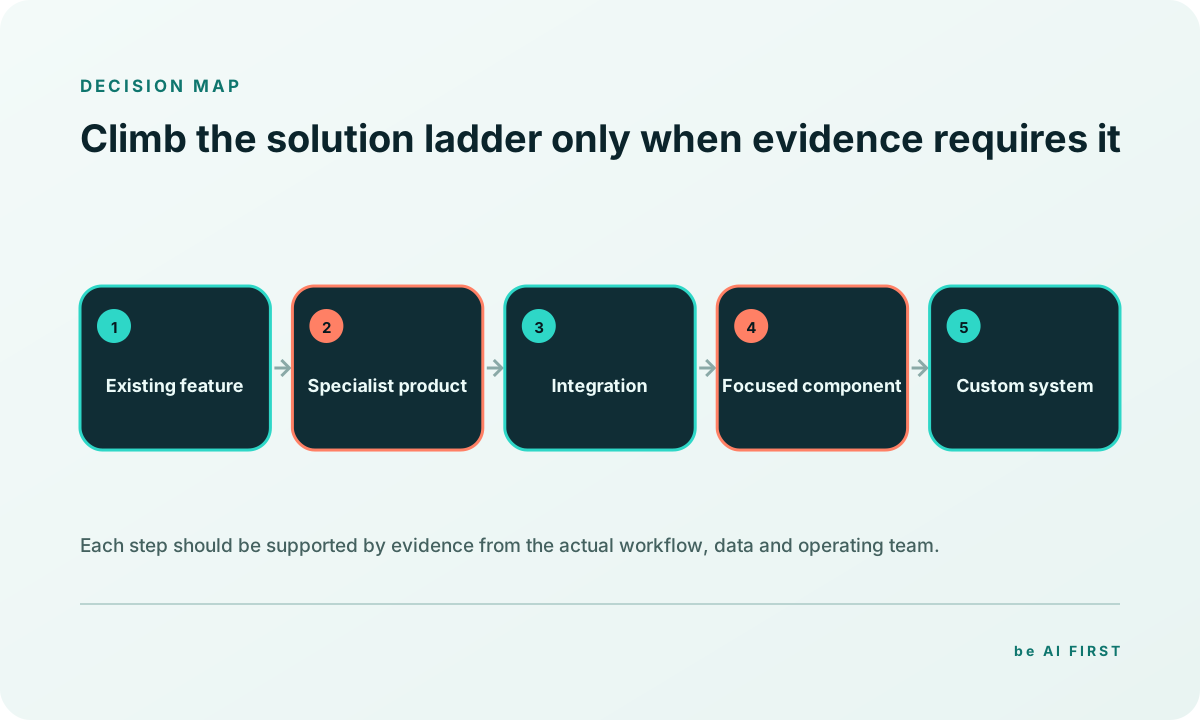
Use a five-step custom AI solution ladder
Move up the ladder only when the simpler level fails a documented requirement.
1. Use the feature you already have
First, check the software that already owns the workflow. It may be a CRM, accounting system, property platform, document suite or industry application.
An included AI feature may already provide drafting, search, summarization, extraction or workflow automation with acceptable permissions and administration. If it solves the problem well enough, adopting it may be faster and safer than adding another system.
Test the exact plan and configuration available to your company. Marketing pages do not prove that the feature can use your data or follow approval rules. They also do not prove that it can operate within your budget.
2. Configure a specialist product
A focused product may solve a common workflow more completely than a general assistant. Configuration can include templates, knowledge sources, roles, approval steps and connectors.
This is a strong option when the process is common across many businesses and your differences fit within supported configuration. The vendor spreads product development, maintenance and support across many customers.
The tradeoff is that the vendor controls the feature roadmap, product limits and much of the operating model.
3. Connect existing systems
Sometimes the AI capability is sufficient. However, it cannot reach the right information or return the result to the place where work happens.
An integration can be the smallest useful custom layer. It may:
- move approved data between systems;
- validate an incoming file;
- retrieve current records;
- call a model through an API;
- apply deterministic business rules;
- write a reviewed result back to the source application;
- record failures and notify an owner.
This approach keeps mature products for the capabilities they already provide while solving the business-specific gap between them.
4. Build a focused custom component
Consider a custom component when the requirement is important and repeatable, yet configuration and integration cannot meet it.
For example, a company may need a proprietary evaluation method or an unusual approval flow. Other cases include specialized data transformation or a customer experience built around the company's intellectual property.
Keep the boundary narrow. A custom decision layer can still use managed identity, databases, storage, model APIs and monitoring. Custom does not have to mean rebuilding the entire technology stack.
5. Build or operate a custom system
A broader custom system may fit when the workflow is central to the business. It may also fit a distinctive experience, specific integration pattern or deployment constraint that available products cannot meet.
This option adds responsibility for testing, security, reliability, support, cost control, documentation and future changes. The decision should account for ongoing operation, not only whether AI-assisted development makes the first version quick to produce.
Microsoft's current guidance for AI workloads recognizes managed software, platform services and custom solutions as different paths. It also emphasizes data design, testing, operations and lifecycle responsibilities.
Test products against the real work
Create a small evaluation set before selecting the option.
Include:
- several ordinary cases;
- difficult cases that experienced staff recognize;
- incomplete or conflicting input;
- a user who should not have access;
- a downstream system or data source being unavailable;
- a result that requires human rejection or correction;
- the expected volume and peak load.
Agree what acceptable means. Measure output quality, review effort, task completion, failure handling, response time and operating cost. A product that generates an impressive answer but cannot fit into the operating workflow has not passed the test.
Use requirements that can actually rule an option out
The following table helps turn preferences into decisions.
| Requirement | Questions to ask |
|---|---|
| Workflow fit | Does it support the actual sequence, approvals and exceptions? Can the business adapt without losing something important? |
| Information access | Can it use the required sources with current data, appropriate permissions and traceable references? |
| Deployment boundary | Where are inputs, outputs, logs and backups processed and stored? Does the exact product meet the approved requirement? |
| Quality | Does it pass representative tests at the level users need? How much correction remains? |
| Integration | Can it read from and write to the systems where the work occurs? Are those interfaces supported? |
| Control | Who can change prompts, rules, sources, permissions and releases? Is rollback possible? |
| Cost | What is the cost per successful task after retries, tools, infrastructure and human review? |
| Operation | Who monitors it, handles failures, updates it and supports users? |
| Exit | Can data and custom work be exported? What must be replaced if the provider or implementation changes? |
A requirement is useful when the team can produce evidence for it. “We want control” is too vague. By comparison, offline operation and manager approval for outbound messages are concrete, testable requirements.
Watch for four expensive decision errors
Building because the prototype was easy
AI can generate code and accelerate implementation. That changes the cost of producing a first version. It does not remove production accounts, access controls, data migrations, testing, monitoring, recovery, support or maintenance.
Review the system your AI assistant proposed before treating speed as proof of fit. Our AI implementation plan review explains how to challenge it before committing data or budget.
Buying because the demonstration looked complete
A vendor demonstration uses selected data and a controlled path. Test the feature with representative work, including exceptions and access boundaries. Confirm the capabilities and terms of the plan you would actually purchase.
Treating customization as training a model
Many business requirements can be met through configuration, retrieval, deterministic rules, integration or a focused application layer. Training or fine-tuning a model is one option, not the default meaning of custom AI.
Ignoring the operating owner
Every option creates responsibilities. A vendor may operate the product. However, your company still owns the process, user access, source-data decisions and adoption. A custom build adds more technical responsibility. Therefore, name the owners before approving the architecture.
A real example: build the missing foundation, not a new model
101 Net Lease came to beAIfirst with a plan developed through work with Claude. The company needed reliable delivery and validation of external deal-data exports. It also needed a structured database that could support an agent-first way of working.
The engagement did not require training a proprietary foundation model or replacing every business application. We reviewed the plan and retained the decisions that fit. Then we changed unsuitable choices and implemented the missing data foundation.
The running system uses private file delivery, completion events, automated validation and Azure SQL ingestion. It also includes failure alerts and operational monitoring. This example shows custom integration around managed services. It does not imply that every investment business needs the same architecture. See the implementation and its scope.
What a useful recommendation should look like
A consultant or internal team should be able to recommend one of these outcomes:
- adopt an existing feature;
- configure a specialist product;
- integrate approved products and systems;
- build one focused custom component;
- build a broader custom system;
- investigate one unresolved dependency;
- make no change because the current process is adequate.
The recommendation should identify the deciding requirement and evidence. It should also state what remains uncertain and who will operate the result.
If every discovery conversation ends with “build custom AI,” you are not receiving an evaluation. You are receiving one vendor's preferred answer.
Bring the workflow, not a request for technology
If you are comparing an existing product, custom proposal or AI-assisted plan, discuss the workflow with Levi. Bring the current process, your existing tool and the requirement it does not meet.
We will focus on the smallest implementation that solves the real gap—whether that means adopting, configuring, integrating or building.