AI Ethics & ResponsibilityMarch 22, 2026· 8 min read

AI Hallucinations: Managing Risk in Business AI

AI hallucinations cost businesses millions yearly. Learn how to detect, mitigate, and build guardrails against AI errors in production.

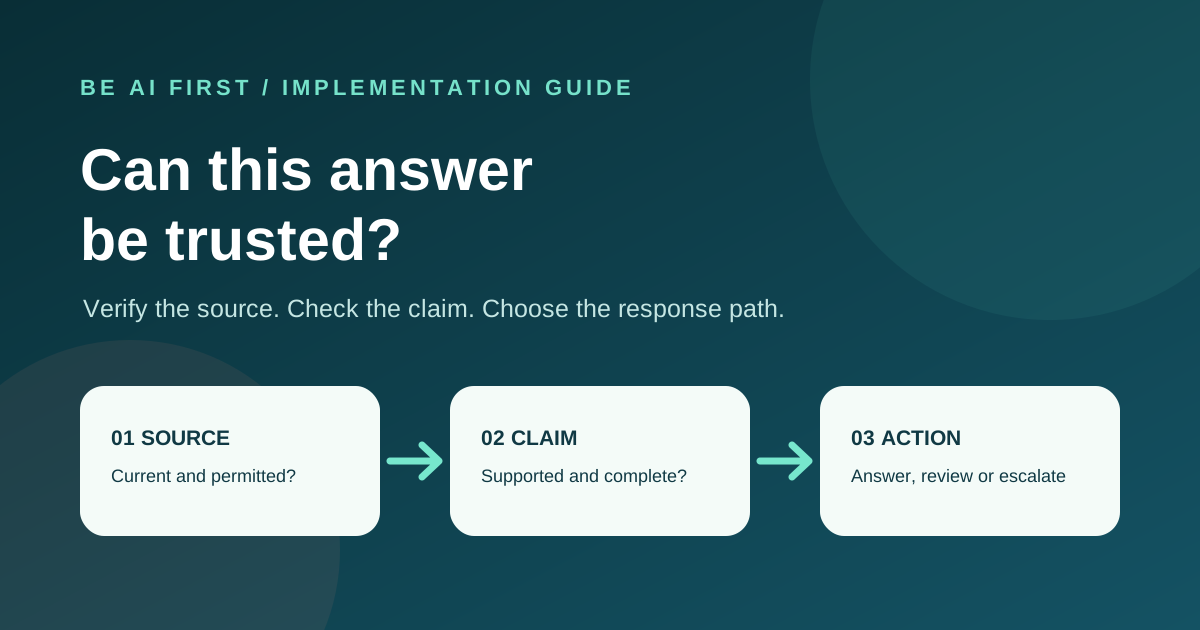
AI hallucinations and ethics — abstract illustration of scales of justice merged with a translucent circuit-board human profile representing AI accountability and responsible AI deployment

AI hallucinations are one of the most misunderstood risks in enterprise AI deployment. When a large language model confidently cites a legal case that never existed, invents a scientific study with plausible-sounding authors and statistics, or generates product information that contradicts your actual specifications, it has hallucinated. The output sounds authoritative. It is completely false.

For businesses deploying AI in customer-facing or decision-critical workflows, this isn't a theoretical concern. AI hallucinations have cost organizations real money — through incorrect legal filings, inaccurate customer advice, flawed financial analysis, and published content containing fabricated facts. Understanding why AI hallucinations happen, where they're most dangerous, and how to build guardrails against them is now a core business competency, not just a technical concern for engineers.

What AI Hallucinations Actually Are

The term "hallucination" in AI refers to outputs generated by AI models that are factually incorrect, fabricated, or inconsistent with reality — presented with the same confident tone as accurate information. The name is apt: just as a hallucinating person experiences something that feels completely real, a hallucinating AI generates text that sounds entirely plausible and authoritative.

AI hallucinations arise from how large language models work. These models are trained to predict the next most likely token (word fragment) given the preceding context. They are optimized for linguistic plausibility, not factual accuracy. When a model lacks specific knowledge about a topic, it doesn't say "I don't know" — it generates the most statistically likely continuation of the text, which may be coherent prose describing events, facts, or sources that don't exist.

The NIST AI Risk Management Framework categorizes hallucination as a significant reliability risk, noting that AI systems may "generate plausible-sounding but incorrect information, particularly when queries extend beyond the system's training data or competence boundaries." NIST recommends that organizations deploying AI implement specific controls to address this risk class.

Understanding why hallucinations happen requires knowing three key patterns:

  • Knowledge gaps: The model was never trained on specific information, so it interpolates from related patterns in ways that produce confident-sounding but false outputs.
  • Training data conflicts: When training data contains contradictory information, models may blend multiple sources in ways that produce internally consistent but factually wrong synthesis.
  • Out-of-distribution queries: Questions that ask models to operate at the edge of their competence — very recent events, highly specialized domains, obscure facts — produce higher hallucination rates.

The Real Business Cost of AI Hallucinations

AI hallucinations have already caused documented harm in business and professional contexts. Understanding these failure modes helps organizations assess their own exposure.

Legal Profession: The Most Publicized Examples

The legal profession has produced the most high-profile AI hallucination incidents. In multiple documented cases, attorneys submitted legal briefs citing judicial opinions generated by AI — opinions that did not exist. Judges imposed sanctions ranging from fines to mandatory AI education requirements. One prominent case involved a brief citing six fabricated precedents, each with plausible-sounding case names, citation formats, and summaries. The attorney, who had used ChatGPT without verification, described the citations as "bogus" only after opposing counsel could not locate them in legal databases.

These cases drove many jurisdictions to adopt disclosure requirements for AI-assisted legal work. Furthermore, they established a clear professional responsibility principle: attorneys who rely on AI-generated legal research without independent verification bear full professional responsibility for the accuracy of what they submit.

Healthcare: High-Stakes Information Errors

AI hallucinations in medical contexts carry consequences far beyond professional embarrassment. AI systems asked about drug interactions, treatment protocols, or diagnostic criteria can produce confident, detailed, and completely wrong information. When healthcare professionals or patients act on this information, the results can be severe.

Several hospital systems that deployed AI-powered clinical decision support tools have implemented mandatory verification requirements specifically because of hallucination risk. The clinical AI tools with the strongest safety records are those designed to cite specific, verifiable sources for every recommendation — making verification straightforward rather than optional.

Financial Services: Compliance and Fiduciary Risk

AI hallucinations in financial contexts create regulatory and fiduciary exposure. An AI assistant that generates incorrect information about investment performance, regulatory requirements, or tax implications — and that information reaches clients — creates liability that can significantly exceed the cost of the AI deployment itself.

According to SEC guidance on AI in financial services, firms are responsible for the accuracy of AI-generated client communications regardless of whether those communications were written by humans or machines. The regulatory standard doesn't change because AI was involved — it may actually be heightened because of AI's known reliability limitations.

Marketing and Content: Brand and Reputational Damage

AI-generated marketing content that includes fabricated statistics, invented customer testimonials, or false product claims creates brand risk and potential FTC exposure for deceptive advertising. Several high-profile brands have faced criticism after publishing AI-generated content containing fabricated research citations or inaccurate factual claims.

The pattern is consistent: AI content created without verification workflows and published at the pace AI enables can accumulate accuracy errors faster than manual review processes can catch them.

How to Detect AI Hallucinations

Detection is the first line of defense against AI hallucination risk. Several practical approaches help organizations identify when AI output may be unreliable.

Source Citation Requirements

The single most effective detection mechanism is requiring AI systems to cite specific, verifiable sources for factual claims. When a model cannot cite a source for a specific claim, that absence is itself meaningful information. Furthermore, when sources are cited, they can be verified against the actual source material.

Prompt engineering that instructs models to cite sources doesn't eliminate hallucination — models can and do fabricate sources. However, it creates a verification checkpoint that catches hallucinations that would otherwise pass undetected.

Confidence Calibration

AI systems that express calibrated uncertainty are significantly more reliable than those that assert everything with equal confidence. Prompts that ask models to explicitly state their confidence level — "on a scale of certain to uncertain, how confident are you in this response?" — surface the model's internal uncertainty in ways that help reviewers prioritize verification effort.

Well-designed AI systems for high-stakes applications should be instructed to say "I don't know" or "I'm not certain" rather than generating plausible-sounding information when facing queries at the edge of their knowledge. Building this behavior requires deliberate prompt design and, in production systems, reinforcement learning from human feedback on appropriate uncertainty expression.

Retrieval-Augmented Generation

Retrieval-Augmented Generation (RAG) is a technical approach that significantly reduces hallucination rates for domain-specific applications. Rather than relying solely on knowledge embedded in the model's parameters, RAG systems retrieve relevant documents from a curated knowledge base and provide them as context for generation. The model's job shifts from recalling facts to synthesizing information it has been explicitly given.

RAG substantially reduces hallucination rates for the categories of information included in the knowledge base, while making verification more tractable because the model's claims can be checked against the source documents it received. Leading enterprise AI deployments for customer service, compliance, and knowledge management increasingly use RAG architecture for exactly this reason.

Cross-Model Verification

For high-stakes applications, running queries through multiple AI models and comparing responses surfaces disagreements that signal potential hallucination risk. When two independently-trained models produce significantly different answers to the same question, at least one is probably wrong — and the discrepancy warrants human verification before either answer is used.

Building Guardrails Against AI Hallucinations

Detection is necessary but not sufficient. Organizations deploying AI in consequential contexts need systematic guardrails that reduce hallucination risk structurally.

Human-in-the-Loop for Consequential Outputs

The most reliable guardrail for AI hallucination risk is human review before any AI output with significant consequences reaches an end user or drives a business decision. This doesn't mean reviewing every AI interaction — that would eliminate the efficiency benefits of AI deployment. It means identifying the specific output categories where errors carry meaningful cost and ensuring those outputs receive human verification.

Tiering outputs by consequence is the practical approach. AI responses to basic customer service queries about hours, policies, or general product information carry different risk profiles than AI outputs about specific medical dosages, legal obligations, or financial recommendations. Design your review requirements proportionally to consequence severity.

Domain-Specific Fine-Tuning and Knowledge Bases

General-purpose AI models have broad but shallow knowledge across all domains. Domain-specific fine-tuning or structured knowledge bases significantly improve accuracy within a specific field — reducing (though not eliminating) hallucination rates for the relevant domain.

A customer service AI fine-tuned on your actual product documentation and trained to stay within its knowledge base rather than guessing will produce dramatically fewer hallucinations about your specific products than a general-purpose model deployed out of the box. The investment in domain-specific customization pays dividends in reliability.

Output Validation Systems

Automated output validation — using AI or rules-based systems to check other AI outputs — catches a meaningful fraction of hallucinations before they reach humans. Validation systems can check whether claims are consistent with known facts in your system of record, flag outputs containing unverifiable citations, identify internally contradictory statements, and detect responses that fall outside expected patterns for the query type.

Validation systems are not foolproof — they share some of the same limitations as the models they're validating. However, as a layer in a defense-in-depth approach, they add meaningful reliability improvement.

Scope Limitation and System Prompts

AI systems that are explicitly instructed to stay within clearly defined scope boundaries produce fewer hallucinations than those given open-ended instructions. A customer service AI told "You assist customers with questions about our product catalog. If a customer asks about something outside our products, say that you're not able to help with that and offer to connect them with a human agent" will produce far fewer hallucinations than one told "Assist customers with any questions they have."

System prompts that define scope clearly, explicitly prohibit guessing when uncertain, and require the model to acknowledge knowledge limitations are one of the most cost-effective hallucination mitigation tools available.

AI Hallucination Risk by Use Case

Not all AI use cases carry equal hallucination risk. Matching your oversight investment to your actual risk profile is essential for efficient AI deployment.

Lower hallucination risk: Creative content generation (fiction, marketing ideation), code generation with test validation, summarization of provided documents, data formatting and transformation, and workflows where the AI operates on explicit context it has been given rather than recalling facts from memory.

Higher hallucination risk: Legal and regulatory information, medical and clinical guidance, financial analysis with factual claims, historical or biographical information about specific people and events, citation and research aggregation, and any domain requiring precise factual recall of specific numbers, dates, or names.

Map your AI applications to this risk spectrum and allocate your verification and oversight resources accordingly. The goal is not zero hallucination risk — that's unachievable with current technology. It's proportional risk management that protects your highest-stakes outputs while allowing AI to operate freely where errors are low-consequence.

AI Hallucinations and Regulatory Compliance

Regulatory frameworks are increasingly addressing AI reliability as a compliance requirement. The EU AI Act, which began phased enforcement in 2025, imposes specific accuracy and reliability requirements on high-risk AI applications — including systems used in healthcare, legal, financial services, and employment decisions.

Under the EU AI Act, providers of high-risk AI systems must implement appropriate testing, validation, and ongoing monitoring to ensure the systems perform as intended and produce accurate outputs. Hallucination rates that would be acceptable for a marketing content tool may not meet the reliability standards required for a medical diagnostic assistant or a credit scoring system.

Even for AI applications outside formal "high-risk" classifications, the regulatory trend is clear: organizations will be expected to demonstrate that they understand the reliability limitations of their AI systems and have implemented appropriate controls. Documenting your hallucination risk assessment, detection mechanisms, and guardrail architecture is increasingly valuable not just for safety but for demonstrating regulatory compliance.

A Practical Framework for AI Hallucination Risk Management

Translating the above into practice, here is the framework we recommend to clients at Be AI First:

Step 1: Audit your existing AI deployments. For each AI application currently in use, document: What outputs does it generate? What are the consequences if those outputs are wrong? Does the application currently have any hallucination detection or verification mechanisms?

Step 2: Classify by risk tier. Based on your audit, classify each application as low, medium, or high hallucination risk based on both hallucination probability (how often could this application hallucinate?) and consequence severity (what happens if it does?).

Step 3: Implement proportional controls. For high-risk applications: implement RAG architecture, require source citation, mandate human review before use. For medium-risk applications: implement output validation, use scope-limited system prompts, conduct periodic sampling review. For low-risk applications: standard best practices for AI deployment, no specialized hallucination controls required.

Step 4: Build a testing cadence. Regularly test your AI applications with adversarial prompts designed to elicit hallucinations. Track hallucination rates over time. Treat increasing hallucination rates as a reliability signal that warrants investigation.

Step 5: Create a disclosure and response protocol. When an AI hallucination does reach an end user or influence a business decision, have a clear protocol for acknowledgment, correction, and remediation. How organizations respond to AI errors matters as much as the frequency of those errors for building stakeholder trust.

AI Hallucinations and Organizational Trust

Managing AI hallucinations isn't just about avoiding errors — it's about building the organizational trust that enables AI adoption at scale. Teams that have experienced an AI hallucination causing real problems become reluctant to rely on AI, even for applications where hallucination risk is low. Conversely, teams that see consistent evidence that their AI systems have appropriate guardrails in place grow more confident deploying AI across higher-stakes use cases.

The organizations that build AI capability most effectively in the coming years will be those that treat AI reliability as a design requirement, not an afterthought. That means building hallucination awareness into your AI procurement and deployment processes from day one — asking vendors about their accuracy benchmarks, requiring transparency about known failure modes, and implementing the verification architectures that match your risk profile.

AI hallucinations are an inherent feature of current-generation AI technology, not a bug that will be fixed in the next model release. The question is not whether to deploy AI despite hallucinations — it's how to deploy AI with hallucinations accounted for, managed, and proportionate to the applications you're using AI for. Organizations that get this right will build AI capability that compounds. Those that don't will spend more time managing AI-caused problems than capturing AI-enabled opportunities.

For more on responsible AI deployment, explore our guide to AI agent security, learn how to evaluate AI tools for your business, or book an AI-First Fit Call to discuss how to build AI systems your organization can actually trust.

About the Author

Levi Brackman

Levi Brackman is the founder of Be AI First, helping companies become AI-first in 6 weeks. He builds and deploys agentic AI systems daily and advises leadership teams on AI transformation strategy.

Learn more →