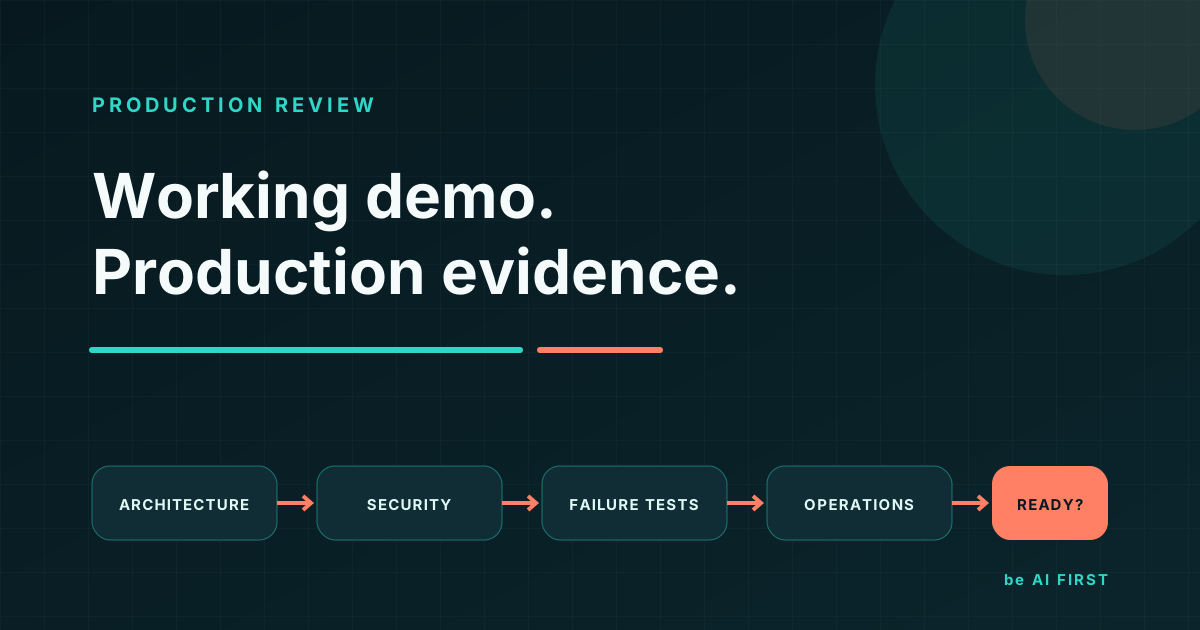
An AI-generated code review answers a business question that a successful demonstration cannot: is this system ready for real users, real data and real failures?
Claude, ChatGPT, Copilot and coding agents can help a founder or operating team move from an idea to working software quickly. That is useful progress. However, a prototype can work in one controlled session while still depending on one person's laptop, broad permissions, untested assumptions or services nobody has agreed to operate.
Therefore, the next step is not to discard the work. It is to review what exists, preserve the sound decisions and close the gaps that matter in production.
AI-generated code review starts with the business promise
Begin with what the system is supposed to do for the business. Do not begin with a line count or a list of frameworks.
Write down:
- who uses the system;
- what event starts the workflow;
- which information it reads or changes;
- what a successful result looks like;
- which mistakes would cause harm;
- who must approve or correct the result.
Then run the current prototype against that promise. A polished interface does not prove that the underlying workflow is complete. Likewise, passing the happy path does not prove that the system can recover when an input is missing or an integration fails.
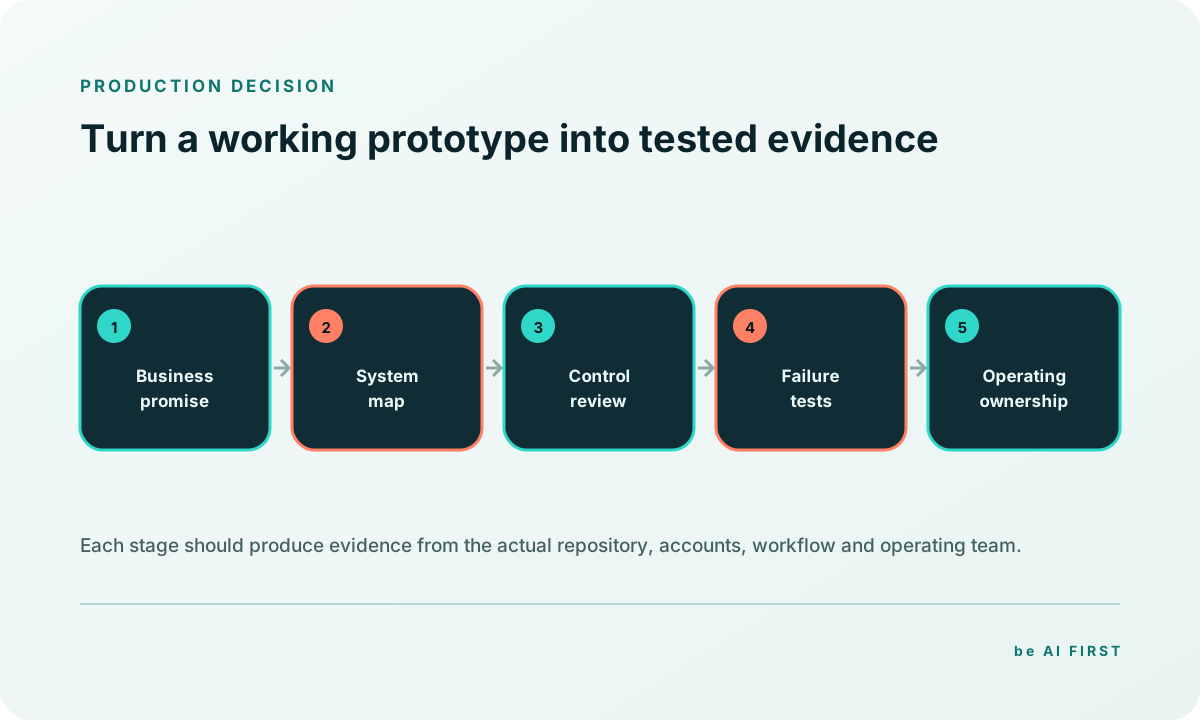
1. Reconstruct the system before changing it
AI-assisted projects often grow through many small conversations. As a result, the code may work even though no current document explains the whole system.
First, create a short, evidence-based map:
- the application and its environments;
- databases, file stores and queues;
- model providers and other external APIs;
- authentication and user roles;
- secrets and service identities;
- scheduled jobs and background workers;
- deployment, monitoring and backup paths.
Confirm the map against the repository, cloud account and running system. Do not assume that a README or an AI-generated explanation matches what is deployed.
This review also identifies accidental dependencies. For example, a scheduled job may rely on a developer's personal token. A database migration may exist only in chat history. A production setting may have been changed manually and never recorded.
2. Decide what to keep, replace or remove
The fastest responsible route is rarely a rewrite. Instead, classify each important decision.
| Decision | Evidence to seek | Possible outcome |
|---|---|---|
| Architecture | Fits the workflow, expected load and team | Keep, simplify or redesign one boundary |
| Dependencies | Real package, maintained version, compatible license | Approve, pin, replace or remove |
| Data model | Represents business records and change rules | Retain, migrate or add constraints |
| AI step | Needs interpretation rather than a fixed rule | Keep AI, add review or make deterministic |
| Provider | Meets access, deployment, cost and support needs | Use as designed or choose another service |
A good review gives reasons. “This looks complicated” is not enough. By comparison, “the job can run twice and create duplicate invoices” is a specific problem that can be tested and fixed.
3. Review security and data boundaries
Check what each user, service and agent can read, write and execute. Then compare that access with the minimum required for the workflow.
Review at least:
- authentication and authorization;
- administrative routes and default accounts;
- secret storage and rotation;
- tenant or customer-data separation;
- input validation and output encoding;
- model prompts, traces and logs that may contain restricted data;
- dependencies and their provenance;
- actions an agent can take without human approval.
GitHub's current guidance for reviewing AI-generated code recommends automated tests and static analysis first. It also calls for checking intent, architecture, dependencies, licensing and maintainability.
The OWASP Secure Coding with AI Cheat Sheet adds AI-specific controls. These include protecting sensitive context, reviewing generated tests and preventing automated changes from weakening security controls.
4. Test failures, not only features
A prototype proves that one path can work. Production testing asks what happens when reality differs from the demonstration.
Choose failures that fit the actual system:
- an input is empty, malformed or duplicated;
- a required API is slow or unavailable;
- a model returns an invalid structure;
- a user lacks permission;
- a background job runs twice;
- a deployment fails halfway through;
- a secret expires;
- a database write succeeds but the next action fails;
- a user rejects the AI output;
- the cost or response time exceeds the operating limit.
For every test, define the expected state, message, log, alert and recovery action. The system should fail in a way an operator can understand.
NIST's Secure Software Development Framework treats code review, analysis and recorded remediation as parts of a secure development process. It also recommends selecting review methods according to the software's stage and risk. That principle matters here: a customer-facing financial workflow needs stronger evidence than an internal experiment.
5. Check maintainability and change safety
For example, the original builder may understand the prototype because they watched every prompt produce it. A future maintainer does not have that context.
Ask whether another qualified person can:
- set up the project from documented instructions;
- run meaningful tests locally and in continuous integration;
- identify the source of configuration values;
- deploy through a repeatable process;
- roll back a defective release;
- trace a failure from the user action to the relevant logs;
- change one feature without guessing which unrelated path will break.
Remove dead experiments and duplicated implementations after their purpose is understood. Then document the important boundaries and business rules. The goal is not extensive documentation. It is enough shared context to operate and change the system safely.
6. Calculate the real operating cost
In addition, prototype costs often reflect one user and a small test dataset. Production cost includes much more than model tokens.
Estimate cost per completed business task across:
- model calls and retries;
- databases, storage and data transfer;
- background jobs and integration services;
- monitoring and retained logs;
- human review and correction;
- support, maintenance and incident response.
Then test the estimate at expected and peak volume. Our AI operating-cost guide explains how to measure cost per successful task without treating the cheapest model call as the cheapest working system.
7. Name the owner before production
Finally, someone must decide when the system is ready. Someone must also handle access requests, failed jobs, provider changes, user reports and future releases.
Record ownership for:
- the business process;
- source data and access approval;
- technical operation;
- security issues;
- AI quality and evaluation;
- vendor accounts and billing;
- release approval and rollback.
Use the AI system handover checklist to turn those responsibilities into acceptance evidence.
What an AI-generated code review should produce
A useful review ends with decisions, not a generic score.
As a result, the output should include:
- a current system and data-flow map;
- the business-critical assumptions that were verified;
- what can remain as built;
- specific defects or risks to fix before production;
- tests that prove the important behavior;
- an operating-cost estimate with stated assumptions;
- named ownership and a release or handover plan;
- a prioritized path from the current prototype to the intended use.
Some prototypes need a focused hardening pass. Others need one integration redesigned or one data boundary corrected. A few should remain experiments. The review should make that distinction before more time and money are committed.
Bring the working prototype
If you built a system with Claude, ChatGPT, Copilot or another coding agent, you do not need to start over. Book a conversation with Levi and bring the repository, a safe demonstration and the business workflow it is meant to support. Do not send credentials or confidential production data.
beAIfirst can review the implementation, retain what works and help turn the remaining gaps into a tested, operable system. Our implementation services cover focused review, integration, data foundations, deployment and ongoing improvement.