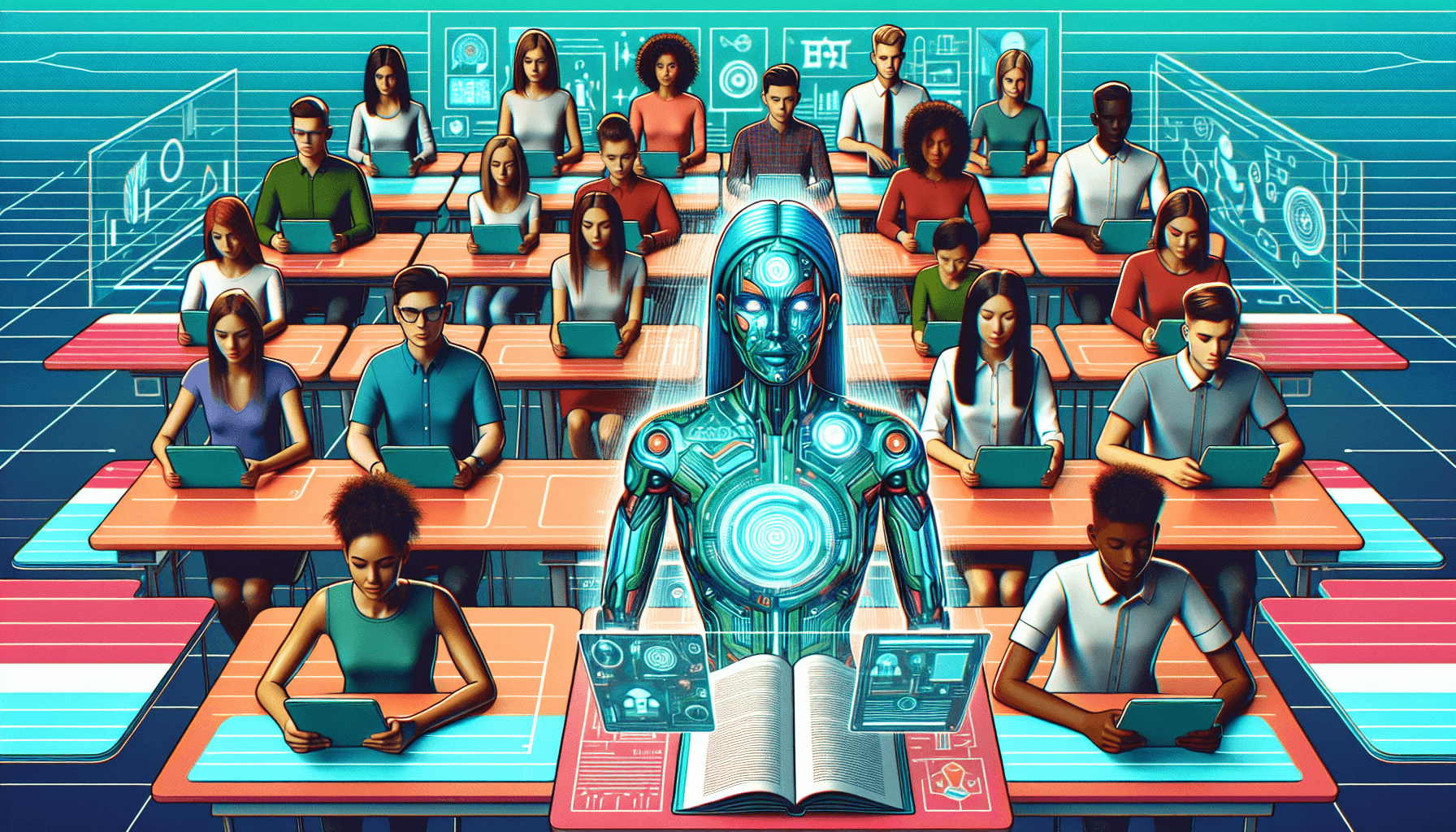
AI in education is no longer a distant promise. Across K-12 schools, community colleges, and research universities, AI tools are actively reshaping how students learn, how teachers teach, and how institutions operate. The shift is happening faster than most policymakers realize — and the institutions that embrace it thoughtfully are pulling ahead in measurable ways.
According to a RAND Corporation study, nearly 40% of K-12 teachers reported using AI tools in their classrooms as of 2025, up from under 10% two years earlier. At the university level, adoption is even higher. The question has shifted from whether to adopt AI to how to deploy it in ways that genuinely improve learning rather than simply automating existing practices.
AI in Education: Personalized Learning at Scale
The most significant contribution AI makes to education is personalization. Traditional classrooms teach to the middle — the student who already understands the material is bored, while the student who is struggling falls further behind. AI changes this dynamic fundamentally.
Adaptive learning platforms powered by AI continuously assess what each student knows, identify gaps, and adjust the pace and content of instruction accordingly. Carnegie Learning's MATHia platform, for example, has demonstrated consistent learning gains in algebra — a subject where US students historically underperform. A series of peer-reviewed studies found that students using MATHia outperformed control groups by an average of 0.2 standard deviations, with larger gains for students who started behind grade level.
This is not a trivial effect. In education research, a 0.2 SD improvement is roughly equivalent to one additional month of learning per school year. Scaled across a classroom, a school, or a district, that compounding effect transforms outcomes.
Beyond math, AI personalization is extending into reading comprehension, writing development, science, and foreign language acquisition. Platforms like Khanmigo (built on Khan Academy's infrastructure) and Duolingo's AI features demonstrate that adaptive instruction improves both engagement and retention compared to static content delivery.
AI Tools That Are Transforming Teachers' Work
A common fear about AI in education is that it will replace teachers. The evidence points in a different direction: AI handles administrative and low-judgment work so teachers can focus on what only humans do well — building relationships, inspiring curiosity, and providing the mentorship that shapes students' lives.
The administrative burden on teachers is enormous and largely invisible. Lesson planning, grading, progress tracking, parent communication, and differentiated instruction planning collectively consume hours every day that teachers would prefer to spend with students. AI is making direct inroads on all of these.
Lesson Planning and Curriculum Design
AI tools like Google's Gemini for Education and Microsoft's Copilot for Teachers allow educators to generate draft lesson plans, suggest differentiation strategies for students at different levels, and create assessments aligned to specific learning standards in minutes rather than hours. A teacher who previously spent two hours Sunday evening planning the week's differentiated reading groups can now produce a solid first draft in 15 minutes and spend the rest of that time refining it based on classroom knowledge that no AI can replicate.
Automated Grading and Feedback
For objective assessments — multiple choice, short answer, math problems — AI grading is now faster and as accurate as human grading. For essay writing, AI writing feedback tools provide students with immediate, specific feedback on structure, argument strength, and clarity rather than waiting days for a teacher to return papers. Students who receive faster feedback learn faster. Teachers who spend less time on rote grading have more capacity for the complex feedback that genuinely develops student thinking.
Early Identification of At-Risk Students
AI systems can analyze patterns in student performance, attendance, and engagement data to identify students at risk of falling behind or dropping out weeks before a human teacher would typically notice. Early warning systems using this approach have shown significant reductions in dropout rates when schools act on the flags they generate. The key is ensuring teachers review and act on these alerts rather than treating them as automated outputs to file away.
Higher Education: AI Is Reshaping Universities
At the university level, AI is simultaneously a tool for learning, a subject of study, and a source of institutional disruption. Universities face a more complex set of questions than K-12 schools because the nature of higher education — critical thinking, original research, intellectual challenge — creates legitimate tensions with AI assistance.
AI as a Research Accelerator
For graduate students and faculty researchers, AI is dramatically accelerating literature reviews, data analysis, and scientific writing. AI tools can synthesize hundreds of papers, identify methodological patterns across studies, and surface connections between research threads that no individual researcher would have time to discover manually. The Nature journal has documented how AI-assisted literature review is shortening the time from hypothesis to experiment design in fields ranging from genomics to materials science.
AI Tutoring and Office Hours
Many universities now deploy AI tutoring systems that give students 24/7 access to homework help, concept explanations, and practice problems. Georgia Tech's AI teaching assistant Jill Watson — deployed in an online CS course — answered thousands of student questions per semester with an accuracy rate that matched human TAs, while freeing those TAs to focus on the harder questions that genuinely required human judgment. Students reported not noticing the difference until the experiment was disclosed.
This kind of scaling is particularly valuable in large introductory courses where student-to-faculty ratios make meaningful individual attention impossible. AI fills the gap that has historically forced students to either struggle alone or wait days for office hours.
Rethinking Assessment in the Age of AI
The rise of AI writing tools has created a genuine crisis in how universities assess learning. If a student can generate a passing essay with AI assistance, what does the essay actually measure? Universities are responding in several ways: moving toward in-class writing, oral examinations, portfolio-based assessment, and project-based learning that emphasizes process over product.
These approaches are arguably better assessments of actual learning than the traditional take-home essay ever was. The disruption AI created in assessment may ultimately force a shift toward evaluation methods that measure understanding rather than the ability to produce polished text under favorable conditions.
AI in Education and the Equity Question
Every discussion of AI in education must address equity. Technology in education has a troubled history: tools intended to democratize learning frequently widen gaps between well-resourced and under-resourced schools rather than closing them.
The risk with AI is real. Schools with strong technology infrastructure, reliable internet access, and technically confident teachers will integrate AI more effectively than schools that lack these foundations. If AI adoption follows historical patterns, it will initially benefit students who are already advantaged.
However, there are genuine reasons for cautious optimism. AI-powered tutoring is far less expensive than human tutoring — a resource historically available only to wealthy families. Adaptive learning platforms can serve students in rural or under-resourced districts who lack access to specialized teachers. AI translation and accessibility tools can support English language learners and students with disabilities more effectively than most current approaches.
The US Department of Education's AI report emphasizes that realizing AI's equity potential requires intentional policy, infrastructure investment, and teacher development — not just deploying tools and hoping for the best. The technology creates the possibility of democratized access to high-quality, personalized learning. Whether that possibility becomes reality depends on choices humans make.
What Educators and Institutions Should Do Now
For school leaders, district administrators, and university faculty navigating AI adoption, the evidence suggests a clear set of priorities.
Start with teacher development, not tools. The most common failure mode in education technology is deploying tools without adequate teacher preparation. Teachers who understand both the capabilities and limitations of AI tools deploy them effectively. Those who receive a tool without training default to using it in the simplest, most superficial way — or avoid it entirely. Teacher professional development should precede broad adoption.
Focus on AI for feedback loops, not just content delivery. The highest-leverage use of AI in classrooms is in tightening the feedback loop between students and instruction. Faster, more specific feedback accelerates learning. Tools that provide immediate, actionable feedback on student work — whether in math, writing, or science — should be prioritized over tools that simply deliver content in a new format.
Engage students as active participants in AI literacy. Students who understand how AI works — its strengths, its failure modes, its biases — are better equipped to use it effectively and to identify when it is misleading them. AI literacy is becoming a foundational skill. Schools that treat it as such, embedding it across the curriculum rather than isolating it in a technology class, will graduate students better prepared for a workforce where AI is ubiquitous.
Design assessment for the AI era from the start. Rather than treating AI as a threat to existing assessment practices, design assessment that is meaningful in a world where AI assistance is available. In-class demonstrations, oral examinations, project portfolios, and iterative drafting processes all assess genuine understanding in ways that AI cannot easily substitute for.
Education's AI Moment Is Now
AI in education is not coming — it is here. The institutions that approach it thoughtfully, with strong teacher development, clear pedagogical goals, and an honest engagement with equity implications, will use it to deliver genuinely better learning outcomes. Those that ignore it will find their students arriving in classrooms already habituated to AI assistance with no framework for using it well.
The stakes are high. Education shapes what the next generation is capable of. Getting AI adoption right in schools and universities is not a technology decision — it is a decision about what kind of society we are building.