Choose your first AI automation.
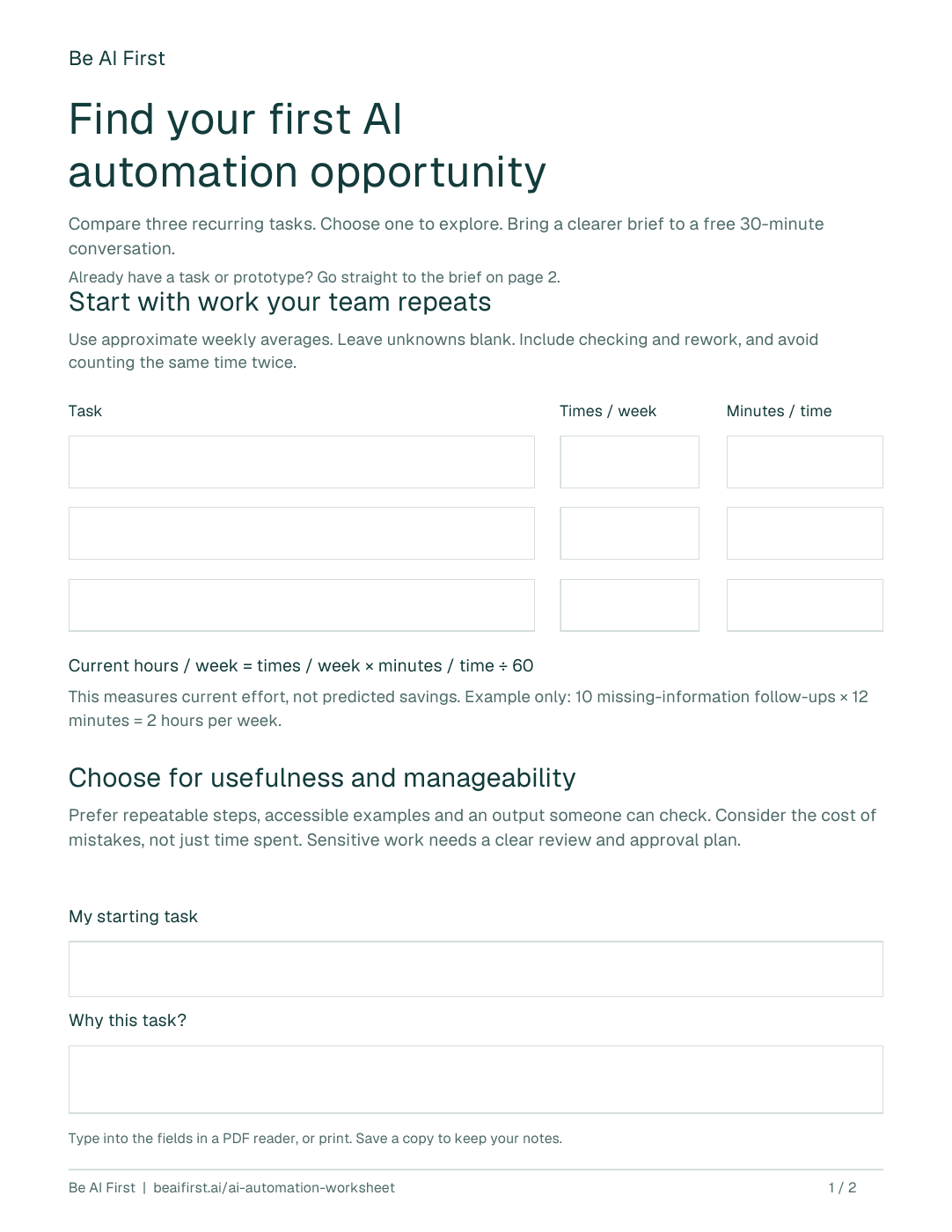
Compare three recurring tasks, choose one manageable starting point, and bring a clearer brief to a free 30-minute conversation.
Download the free worksheet (PDF)Prefer to talk it through? Explore the free consultation.
Two pages. Fill it in digitally or print it. No email required.
Already have a task or prototype? Start with the brief on page two.
Your answers stay in your copy until you choose to share them. Downloading does not send us your business information.
Turn a recurring task into a useful starting point.
Spot the repeated work
List three tasks that involve chasing information, copying records, checking documents or applying the same rules. Include the time spent checking and correcting the work.
Choose a manageable starting point
Look for repeatable work, accessible examples and an outcome a person can check. Flag sensitive information and costly mistakes before automating anything.
Describe a small test
Name the input, the result you need and the person who will review it. Decide what you would need to see before using it in everyday work.
You do not need AI expertise or a complete plan. “I don’t know yet” is a useful answer. An existing tool or a simpler process may be enough.
A clearer brief, without the technical jargon.
The second page helps you describe the work, its boundaries and what a useful test would show. Use descriptions or invented examples, not confidential records, customer details or credentials.
- What starts the task, and where does information arrive?
- For example: a request by email, a spreadsheet or a record in your existing system.
- What should a useful result look like?
- Describe the finished work, where it needs to go and how someone checks it.
- What tools do you already use?
- List the relevant software. A feature you already have may be enough.
- What needs approval, and what could go wrong?
- Note sensitive information, costly mistakes, approvals and who handles exceptions.
- Who will review a small test, and how will you judge it?
- Name a reviewer and a checkable result, such as accuracy, time or fewer missed steps.
- What is still unknown or needs checking?
- It is fine to leave questions open. Bring them to the conversation.
See a filled-in example
- Task
- Request missing details from supplier invoices.
- Input
- An invented invoice with a missing property reference.
- Output
- A draft email asking the supplier for that reference.
- Tools
- The existing shared inbox and property list.
- Human check
- An administrator checks the recipient and wording before sending. Unclear cases stay with them.
- Small test
- Try ten invented examples. Check that each draft asks for the right missing detail without inventing information.
Illustrative example, not a client result or a recommended acceptance threshold.
For example, a missing-invoice-information workflow could draft a request for a staff member to check before sending. If the details are unclear, the task stays with that person. This is an illustration, not a recommendation to automate payments or professional judgments.
The time calculation estimates your current workload. It is not a forecast of savings, a feasibility assessment or a recommendation to buy software.
Start with the work, as we did for E and E Investments.
For this New Haven-area property-management business, we automated owner-fee calculations, organized bills across inboxes by property and reconciled bank activity with management records.
“Be AI First has saved us a tremendous amount of time and money.”
Bring one task. We’ll help you think through the next step.
Bring your worksheet to a free 30-minute conversation with Levi Brackman. We will discuss the task, what already exists and whether a focused test makes sense.
Identify what needs checking and discuss a sensible next step: use an existing tool, explore a small test or clarify the task before building.
Book a free 30-minute conversationYou can describe the workflow without sharing confidential records on the call. A completed worksheet is optional. No obligation to start a project. We agree scope and fees before any paid work.
Before you download
Do I need to give you my email?
No. The worksheet downloads directly. If you book a consultation, the booking form asks for the details needed to arrange the conversation.
Can I use it without booking?
Yes. Use it with your team or keep it for your own planning. You do not need to complete it to speak with us.
What if I already have an AI plan or prototype?
Choose one unfinished workflow and describe the result you want, what currently works and what is getting in the way. Bring your plan or prototype to the conversation.
Will AI definitely be the right answer?
No. Existing software, an integration or a process change may be more appropriate. The worksheet helps frame that decision; it does not settle it.