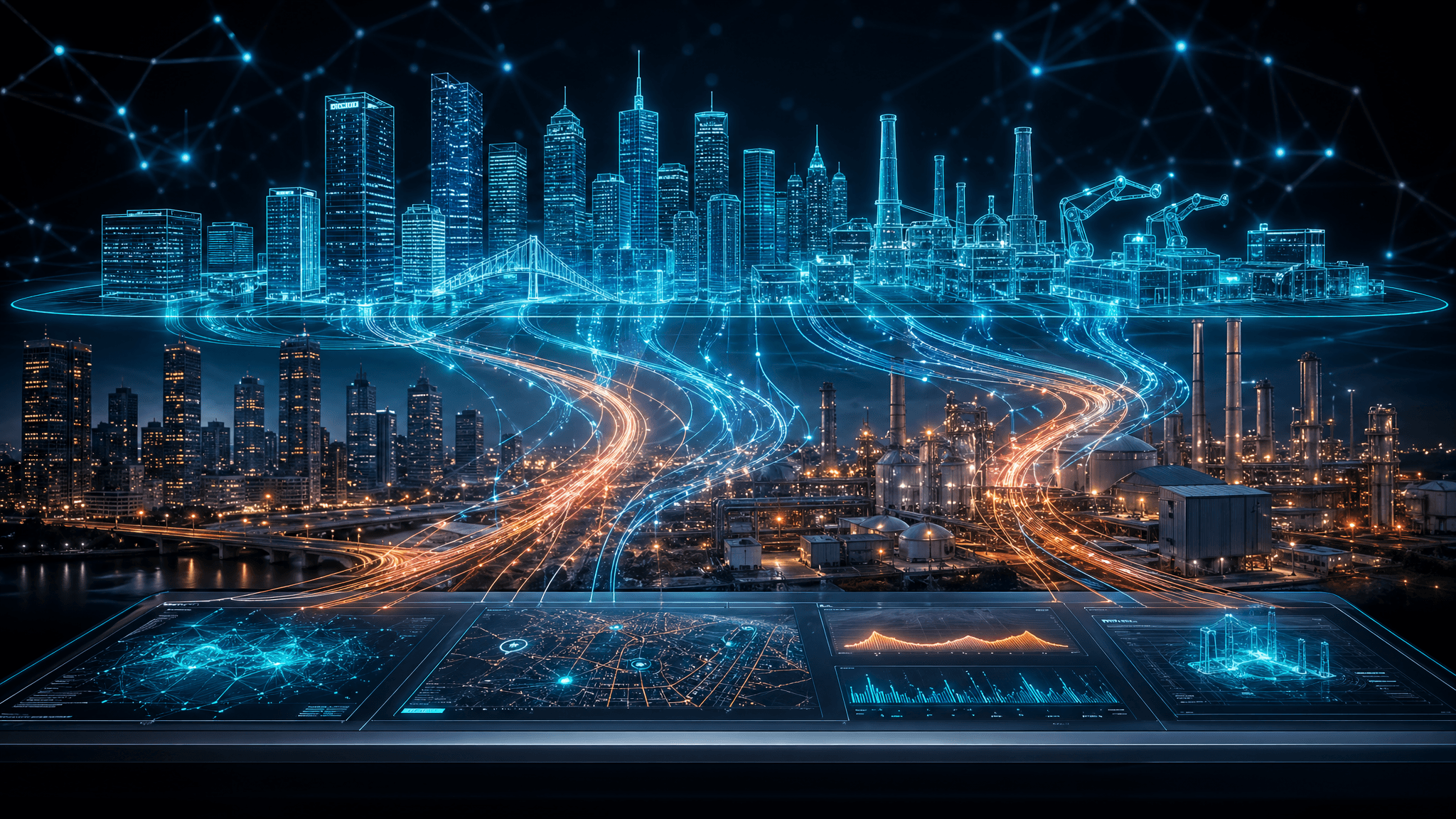
AI digital twins have moved from aerospace experiments to mainstream business operations faster than almost any enterprise technology in recent memory. The global digital twin market reached an estimated $35.8 billion in 2025 and is projected to exceed $328 billion by 2033, growing at a compound annual rate above 31%. For business leaders, this growth signals that virtual replicas of physical assets, processes, and entire facilities are no longer a novelty reserved for Fortune 100 manufacturers. They are becoming a core operational tool that delivers measurable returns across industries.
An AI digital twin is a virtual model of a real-world object, system, or process that continuously ingests live data — from IoT sensors, enterprise software, and operational databases — to mirror its physical counterpart in real time. What makes today's digital twins different from earlier simulation tools is the integration of artificial intelligence. AI enables these virtual replicas to predict failures before they occur, optimize performance autonomously, and recommend actions that human operators can review and approve. The result is a living, learning model that gets smarter over time.
This guide explains what AI digital twins are, how leading companies use them, the concrete business outcomes they deliver, and a practical framework for getting started.
AI Digital Twins: Why They Matter Now
Three converging forces have pushed AI digital twins from concept to competitive necessity in 2026.
IoT Infrastructure Has Matured
Digital twins depend on continuous data from the physical world. Five years ago, deploying the sensors, edge computing, and connectivity required to feed a digital twin was a major capital project. Today, IoT sensors cost a fraction of their 2020 prices, 5G networks provide the bandwidth for real-time data streams, and cloud platforms handle the compute. The infrastructure barrier that once limited digital twins to aerospace and automotive giants has largely disappeared.
Additionally, open data frameworks like NVIDIA Omniverse and OpenUSD have standardized how digital twin data flows between systems. This interoperability means businesses can build digital twins that integrate data from multiple vendors and platforms without custom middleware for every connection. The technical foundation is ready for enterprises of every size.
AI Makes Digital Twins Intelligent
Earlier digital twins were essentially dashboards — they showed you what was happening. AI-powered digital twins tell you what will happen and what to do about it. Machine learning models trained on historical and real-time data identify patterns that human operators miss. A digital twin of a manufacturing line does not just display current throughput; it predicts which machine will fail next Tuesday and recommends rescheduling production to avoid downtime.
This predictive capability transforms the economics of digital twins. According to IBM's research on digital twin technology, 92% of companies that deploy digital twins report returns above 10%, while over half report at least 20% return on investment. The AI layer is what converts a visualization tool into a decision engine that pays for itself.
Business Complexity Demands Better Tools
Modern supply chains span continents. Manufacturing processes involve thousands of variables. Building operations consume energy across dozens of interconnected systems. Managing this complexity with spreadsheets, periodic inspections, and human intuition alone leaves enormous value on the table. AI digital twins give operations leaders a way to see, simulate, and optimize entire systems — not just individual components — in real time.
How Businesses Use AI Digital Twins Today
Digital twin adoption spans every major industry. Here are the use cases delivering the strongest results in 2026.
Manufacturing and Production
Manufacturing leads digital twin adoption because the combination of expensive equipment, complex processes, and tight margins makes optimization especially valuable. A digital twin of a production line ingests data from sensors on every machine — vibration, temperature, power consumption, output quality — and builds a continuously updated model of the entire operation.
The AI layer identifies subtle patterns that precede equipment failures, often days or weeks before a human operator would notice anything wrong. This enables predictive maintenance that replaces scheduled maintenance, reducing both unplanned downtime and unnecessary servicing of healthy equipment. Manufacturers deploying AI digital twins consistently report 20-30% reductions in maintenance costs and significant improvements in overall equipment effectiveness.
Beyond maintenance, manufacturing digital twins optimize production scheduling, energy consumption, and quality control. When you can simulate a proposed change to the production line before implementing it physically, you eliminate the costly trial-and-error that traditionally accompanies process improvement. For a deeper look at AI in manufacturing, see our smart factory guide.
Supply Chain and Logistics
Supply chain digital twins create a virtual model of the entire logistics network — warehouses, transportation routes, supplier relationships, inventory levels, and demand patterns. AI analyzes this model to identify bottlenecks, predict disruptions, and recommend optimal inventory positioning.
When a port closure or supplier delay threatens delivery schedules, the digital twin simulates alternative routing options and quantifies the cost and timeline impact of each one. Operations teams make better decisions faster because they can see the downstream effects of disruptions before they propagate through the network. Our AI supply chain management guide covers specific implementation strategies for logistics operations.
Commercial Real Estate and Facilities
Building operators use digital twins to optimize energy consumption, space utilization, and maintenance across entire portfolios. A digital twin of a commercial building integrates data from HVAC systems, lighting, occupancy sensors, and weather forecasts to minimize energy costs while maintaining occupant comfort.
The results are substantial. AI-optimized building digital twins typically reduce energy consumption by 15-25% compared to traditional building management systems. For a portfolio of commercial buildings, that translates to millions of dollars in annual savings. The digital twin also extends equipment life by detecting degradation patterns early and scheduling maintenance before costly failures occur.
Healthcare and Life Sciences
Healthcare digital twins represent one of the most promising — and most complex — applications of the technology. Hospital operations digital twins optimize patient flow, staffing levels, and resource allocation by simulating demand patterns and capacity constraints. Pharmaceutical companies use digital twins of manufacturing processes to ensure consistent drug quality while reducing waste.
The frontier of healthcare digital twins is personalized medicine: virtual models of individual patients that simulate how different treatments might work based on that patient's specific biology. While patient-level digital twins are still largely in research, operational digital twins for hospital management and pharmaceutical manufacturing are already delivering measurable returns. Our AI healthcare guide explores these applications in detail.
Energy and Utilities
Energy companies operate some of the most asset-intensive businesses on earth. A single wind farm involves hundreds of turbines, each with thousands of components, operating in harsh conditions. A digital twin of the wind farm monitors every turbine in real time, predicts component failures, and optimizes power output based on weather conditions and grid demand.
For utilities, digital twins of the distribution network identify inefficiencies, predict demand peaks, and simulate the impact of adding renewable energy sources. As the energy transition accelerates, digital twins give utilities the analytical tools to manage increasingly complex grids that balance traditional generation, renewables, and distributed energy storage.
The Technology Behind AI Digital Twins
Understanding the technology stack helps business leaders make informed decisions about build-versus-buy and vendor selection.
Data Layer: Sensors and Integration
Every digital twin starts with data. IoT sensors capture physical measurements — temperature, pressure, vibration, flow rates, position, humidity — and transmit them to the digital twin platform. Enterprise systems like ERP, MES, and SCADA contribute operational data. External data sources — weather, market prices, supplier information — add context.
The data integration challenge is often the hardest part of a digital twin deployment. Physical assets use different sensor protocols. Enterprise systems store data in different formats. Getting all of this data flowing reliably into a unified model requires careful architecture. Microsoft Azure Digital Twins and NVIDIA Omniverse both provide platform-level solutions for this integration challenge, though many organizations supplement these with custom connectors for legacy systems.
Model Layer: Physics and AI
The digital twin model combines physics-based simulation with machine learning. Physics models encode known relationships — how heat transfers through a building, how stress accumulates in a turbine blade, how fluid flows through a pipe. Machine learning models capture patterns that physics alone cannot predict — gradual equipment degradation, demand fluctuations driven by human behavior, quality variations caused by subtle interactions between process variables.
The most effective digital twins blend both approaches. Physics models provide the structural foundation and ensure predictions respect physical laws. AI models fill the gaps where physics is too complex or too slow to compute, and they improve over time as more data accumulates. This hybrid approach delivers more accurate predictions than either method alone.
Visualization and Interaction Layer
The visualization layer makes the digital twin accessible to human operators. Modern digital twin platforms render 3D models of physical assets that update in real time, overlaid with data visualizations, alerts, and AI-generated recommendations. Operators can navigate virtual environments, inspect specific components, and run what-if simulations through intuitive interfaces.
This layer matters more than many organizations initially realize. A digital twin that only data scientists can query delivers far less value than one that operations managers, maintenance technicians, and executives can all interact with — each at their appropriate level of detail. The best platforms provide role-based views that give each user the information they need without overwhelming them with data they do not.
Measuring Digital Twin ROI
Digital twin investments require clear return metrics. Here are the categories where organizations consistently measure impact.
Reduced unplanned downtime. Predictive maintenance powered by digital twins catches failures before they happen. The value calculation is straightforward: multiply the cost of an hour of unplanned downtime by the number of hours prevented. For manufacturing operations where downtime costs tens of thousands of dollars per hour, even a few prevented incidents per year can justify the entire digital twin investment.
Optimized energy consumption. Building and industrial digital twins that optimize HVAC, lighting, and process energy use typically deliver 15-25% energy cost reductions. With energy prices volatile and sustainability reporting requirements expanding, these savings compound over time.
Faster product development. Digital twins of products enable virtual testing and iteration without building physical prototypes. Automotive and aerospace companies report reducing development cycles by months when they simulate designs digitally before committing to physical production. The cost savings from fewer prototypes and the revenue impact of faster time-to-market both contribute to ROI.
Improved quality and yield. Manufacturing digital twins that optimize process parameters reduce defect rates and increase yield. For industries with thin margins — electronics, pharmaceuticals, food processing — even small yield improvements translate to significant bottom-line impact. For a broader framework on measuring AI returns, see our AI ROI measurement guide.
Your 30-Day Digital Twin Action Plan
Here is a practical path from exploration to implementation.
Week 1: Identify your highest-value asset or process. The best first digital twin targets a single asset or process that is expensive to operate, prone to failures, or critical to production. Do not start with an entire facility. A single production line, one building, or a critical piece of equipment gives you a focused scope that delivers measurable results quickly. Map the data sources available for this asset — existing sensors, maintenance records, operational logs — and identify gaps.
Week 2: Evaluate platforms and data readiness. Assess whether your data infrastructure can support a digital twin. Do you have sensors generating real-time data? Is your operational data accessible through APIs? Evaluate platforms from NVIDIA, Microsoft, Siemens, or GE based on your industry, existing technology stack, and integration requirements. Our AI tool evaluation framework provides criteria for making this assessment systematically.
Week 3: Build a proof of concept. Deploy a minimal digital twin for your selected asset. Connect available data sources, build a basic model, and start collecting real-time data. The goal is not a production-ready system — it is a working prototype that demonstrates the data flow, identifies integration challenges, and produces initial insights that stakeholders can evaluate.
Week 4: Measure and plan expansion. Analyze the insights from your proof of concept. Quantify the value of predictions and optimizations against historical performance. Build the business case for a production deployment with specific ROI projections. Define the roadmap for expanding to additional assets, processes, or facilities based on value potential. For guidance on building the governance framework around your digital twin program, our AI governance guide covers the policies that ensure responsible deployment.
Common Challenges and How to Overcome Them
Data quality and availability. Digital twins are only as good as the data feeding them. Many organizations discover that their sensors are unreliable, their data is siloed, or their historical records are incomplete. Address this incrementally: start with the data you have, identify the highest-value gaps, and invest in sensor upgrades and integration as the digital twin proves its worth. Perfect data is not required at launch — it is built over time.
Organizational adoption. The most technically sophisticated digital twin fails if operators do not trust or use it. Involve operations teams from the design phase. Show them how the digital twin makes their jobs easier — better information, earlier warnings, fewer surprises — rather than presenting it as a surveillance tool. Our AI change management guide covers strategies for driving adoption across teams.
Integration complexity. Connecting sensors, enterprise systems, and AI models into a unified digital twin requires careful architecture. Legacy systems that were never designed for real-time data sharing are the most common bottleneck. Budget time and resources for integration work — it typically accounts for 40-60% of the total digital twin deployment effort.
Security and privacy. Digital twins that mirror sensitive operations — pharmaceutical manufacturing, critical infrastructure, healthcare facilities — create new attack surfaces. A compromised digital twin could reveal proprietary processes or provide adversaries with detailed knowledge of physical systems. Apply the same security rigor to digital twins as you would to any system with access to sensitive operational data.
Where AI Digital Twins Are Heading
Three developments will shape the next 12 to 18 months of digital twin evolution.
Generative AI integration. Large language models are making digital twins conversational. Instead of navigating complex dashboards, operators will ask questions in plain language: "Why did Line 3 slow down last night?" or "What happens if we increase production by 15% next week?" The digital twin, powered by a language model that understands the underlying data, will provide answers, explanations, and recommendations in natural language. This dramatically lowers the expertise barrier and expands who can benefit from digital twin insights.
Autonomous optimization. Today's digital twins primarily recommend actions for human approval. The next generation will execute optimizations autonomously within defined boundaries — adjusting HVAC settings in real time, rebalancing production schedules automatically, or rerouting logistics without human intervention. Human oversight will shift from approving individual actions to setting policies and boundaries within which the digital twin operates independently. The principles from agentic AI for business apply directly to this evolution.
Composable digital twins. Organizations will connect individual digital twins — a building twin, a supply chain twin, a fleet twin — into enterprise-wide models that capture the interactions between systems. A retailer's composable digital twin might connect store operations, supply chain logistics, and customer behavior models into a single optimization surface. This whole-enterprise view is where the largest value gains will emerge, though the technical and organizational complexity is substantial.
The Bottom Line
AI digital twins represent a fundamental shift in how businesses understand and optimize their physical operations. The technology has matured past the proof-of-concept stage and into production deployments that deliver consistent, measurable returns. The market is growing above 31% annually because organizations that deploy digital twins gain operational advantages — reduced downtime, lower energy costs, faster development cycles, and better decision-making — that directly impact their bottom lines.
The barriers to entry have fallen dramatically. IoT sensors are affordable. Cloud platforms handle the compute. Open frameworks enable interoperability. AI models add the intelligence that turns raw data into actionable predictions. The remaining challenge is not technological — it is organizational. Building the data infrastructure, developing the expertise, and driving adoption across operations teams requires deliberate effort and sustained investment.
Start with one high-value asset. Prove the concept with real data and measurable outcomes. Then expand methodically based on demonstrated returns. The organizations that build digital twin capability now will operate with a level of visibility and optimization that their competitors cannot match — because you cannot optimize what you cannot see, and AI digital twins let you see everything.